XVI Ukrainian Internet Governance Forum (IGF-UA 2025)

XVI Ukrainian Internet Governance Forum (IGF-UA 2025)

XVI Ukrainian Internet Governance Forum (IGF-UA 2025)

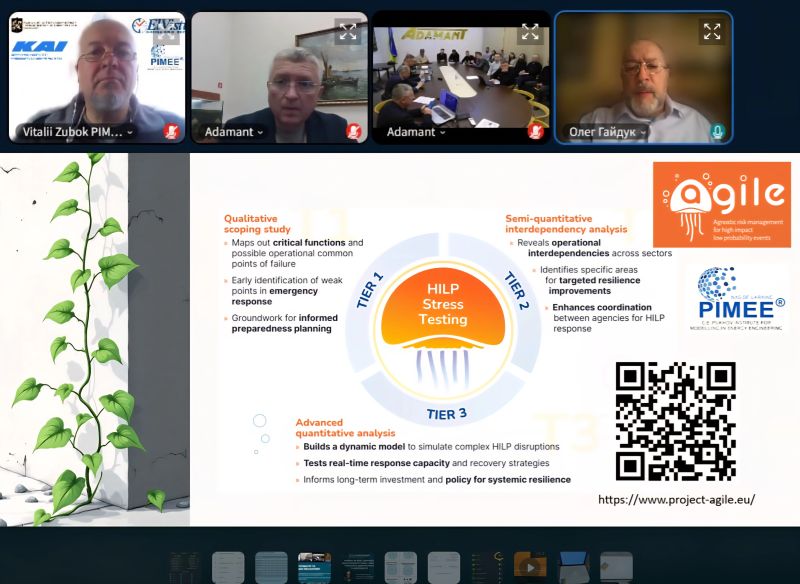
The AGILE project was represented at the XVI Ukrainian Internet Governance Forum (IGF-UA 2025), where Vitaly Zublok (PIMEE, Ukraine) contributed to discussions on “Stress-testing of Digital Infrastructure.”

The session addressed digital resilience as a growing challenge for critical infrastructure management. Stress-testing of digital systems is increasingly recognised as an essential component of sustainable infrastructure governance, extending beyond traditional “strength tests” to examine how systems operate, recover, and adapt over time—not only during an initial shock, but in the minutes, hours, days, and weeks that follow.

Within this context, AGILE is developing a three-tier stress-testing methodology for complex cyber-socio-technical systems. Currently, Tier 1 and Tier 2 stress tests are being implemented through case studies, involving system operators, stakeholders, and public authorities. These activities support the analysis of negative scenarios, cascading effects, and resource needs, contributing to improved adaptation and recovery strategies.

The outcomes of this work will inform future international practices and recommendations aimed at strengthening the resilience of critical digital infrastructures.
6th Annual Meeting of the Society for Risk Analysis Europe – Iberian Chapter

6th Annual Meeting of the Society for Risk Analysis Europe – Iberian Chapter

6th Annual Meeting of the Society for Risk Analysis Europe – Iberian Chapter

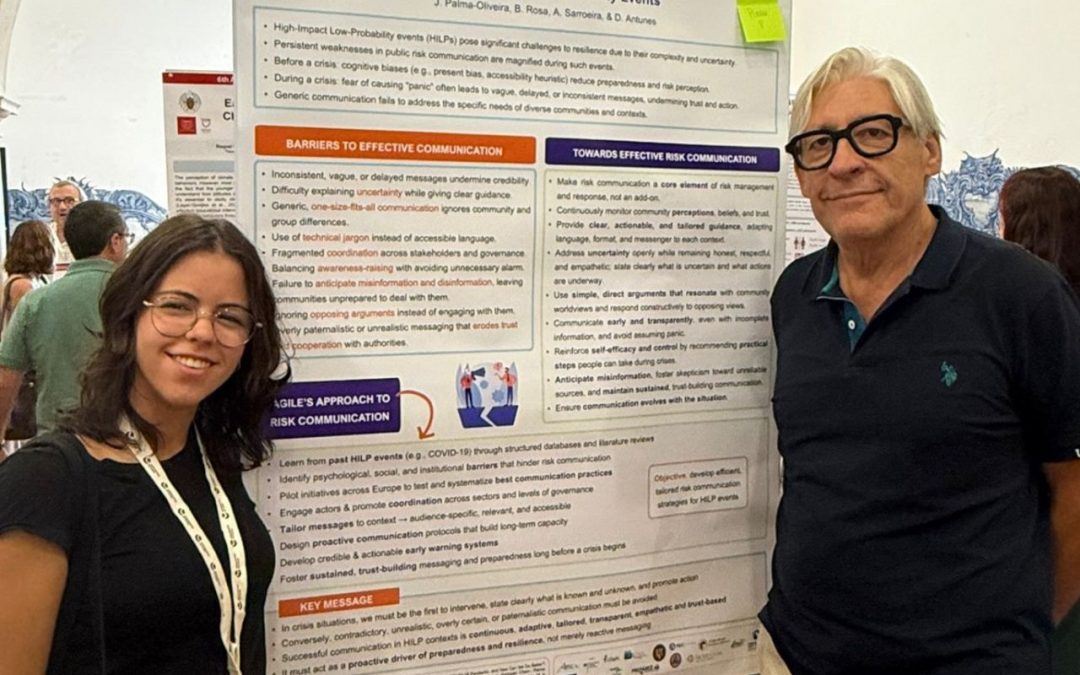
 On 18–19 September 2025, Factor Social took part in the 6th Annual Meeting of the Society for Risk Analysis Europe – Iberian Chapter, hosted at the University of Évora, Portugal, under the theme “Systemic risks in a changing world: Bridging science and society for evidence-based practice”.

Our partners, Beatriz Rosa and José Manuel Palma-Oliveira presented two posters developed within the AGILE Project:

  • Preparing for the Unpredictable: A Framework for Threat-Agnostic Resilience Stress Testing
  • Taming Uncertainty: Risk Communication in High-Impact Low-Probability Events

These contributions reflect the AGILE project’s approach to strengthening resilience by advancing threat-agnostic stress testing and enhancing risk communication for HILP events, thereby supporting preparedness for uncertain and complex risks.

ESREL SRA-E 2025

ESREL SRA-E 2025

ESREL SRA-E 2025

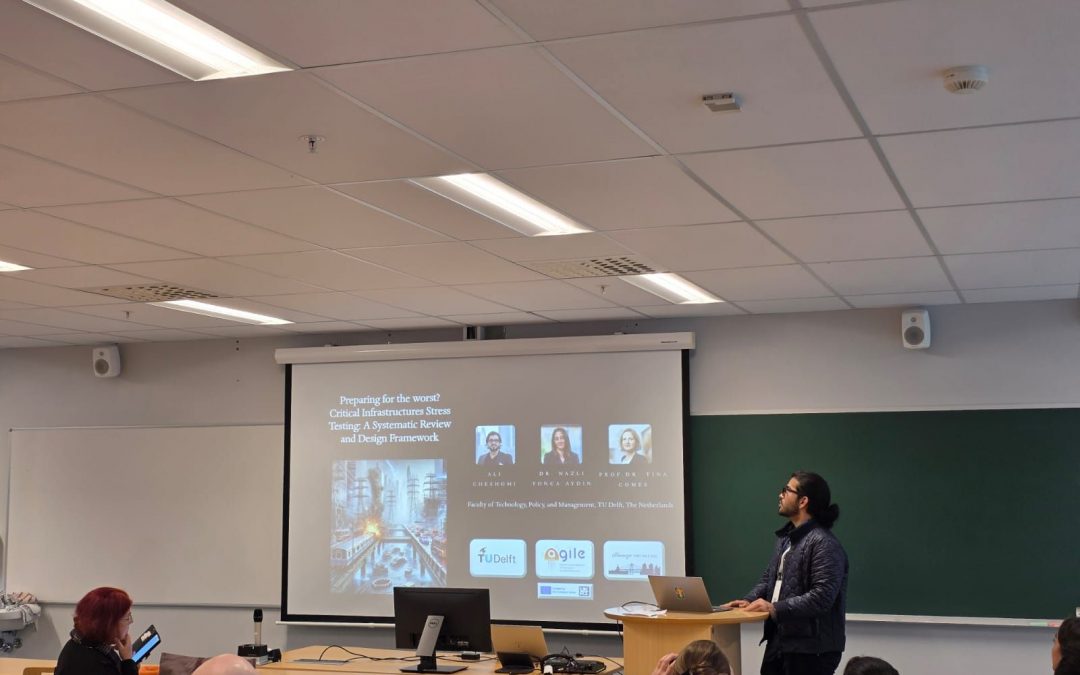
The AGILE project was actively represented at ESREL SRA-E 2025, held in Stavanger, Norway.

At ESREL SRA-E 2025, Ali Cheschomi, together with Nazli Yonca Aydin and Tina Comes from Delft University, presented a systematic review on stress testing of critical infrastructures. The presentation introduced a conceptual framework aimed at supporting the development of new stress-testing methodologies better suited to address High Impact Low Probability (HILP) events. The conference provided a valuable platform for exchanging insights with researchers and practitioners working at the intersection of risk analysis and resilience.

World Bosai Forum 2025

World Bosai Forum 2025

World Bosai Forum 2025

The World Bosai Forum in Sendai brought together global experts and citizens to tackle disaster risk reduction. The concept of Bosai, encompassing actions before, during, and after disasters, resonates deeply with the AGILE project’s mission to enhance resilience against High Impact Low Probability (HILP) events.


AGILE at the World Bosai Forum

EU-Japan Forum on Research and Innovation Communication in Support of Disaster Societal Resilience and Risk Governance

EU-Japan Forum on Research and Innovation Communication in Support of Disaster Societal Resilience and Risk Governance

EU-Japan Forum on Research and Innovation Communication in Support of Disaster Societal Resilience and Risk Governance

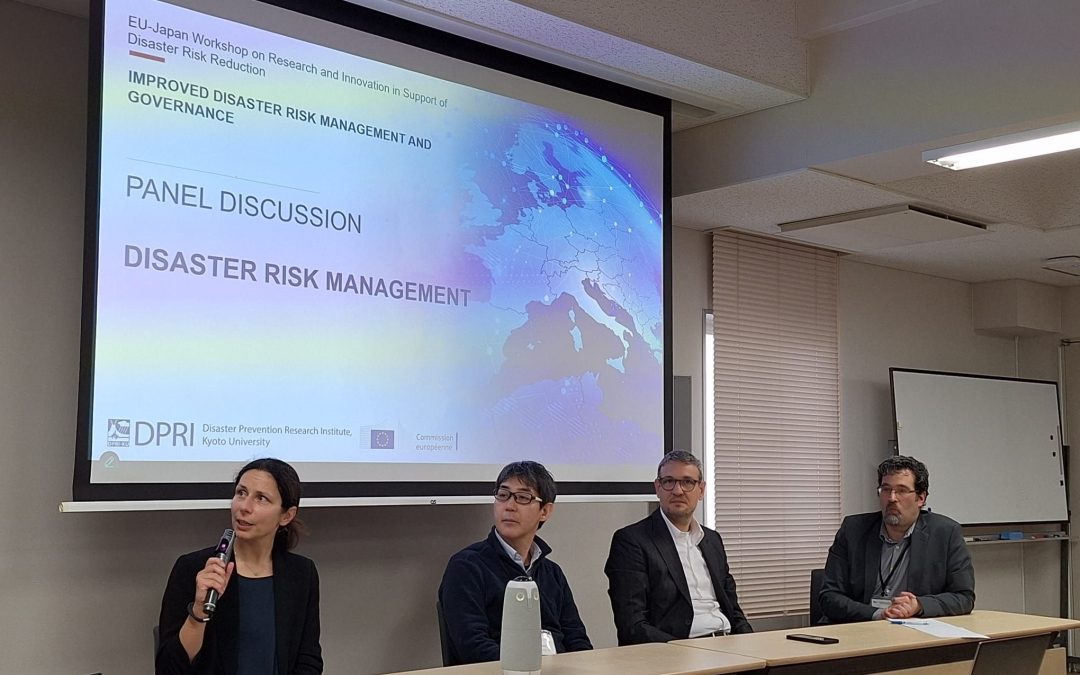
AGILE project participated in the EU-Japan Forum on Research and Innovation Communication in Support of Disaster Societal Resilience and Risk Governance, held at Kyoto University (Uji Campus) on 3–4 March 2025.

Organised in cooperation with the Community for European Research and Innovation for Security (CERIS), the forum brought together EU-funded projects, policymakers, researchers, first responders, and industry experts to address key challenges in disaster risk governance and societal resilience, with a particular focus on strengthening the link between research, innovation, and real-world implementation.

The AGILE project was represented by its Project Coordinator, Gordana Cveljo (Johanniter-Unfall-Hilfe e.V.), together with partners from UCL Risk & Disaster Reduction (RDR), CMCC Foundation – Centro Euro-Mediterraneo sui Cambiamenti Climatici, and Tohoku University.

AGILE Project Contributions

  • Disaster Preparedness Panel (4 March 2025)
    “Enhanced preparedness and management of high-impact, low-probability (HILP) or unexpected events”
    Gordana Cveljo presented AGILE’s perspectives on improving preparedness and response strategies for high-impact and unforeseen disasters.
  • Governance Panel (4 March 2025)
    “The importance of foresight in planning for disaster”
    Prof. David Alexander (UCL Risk & Disaster Reduction) contributed insights on how foresight and proactive risk anticipation can strengthen disaster preparedness and governance frameworks.

The forum provided an engaging and thought-provoking platform for exchange between European and Japanese stakeholders, highlighting the importance of international collaboration in disaster risk reduction and resilience-building.

The AGILE consortium extends its sincere thanks to Philippe Quevauviller for his leadership in organising this impactful event, and to CERIS and Kyoto University for hosting and facilitating this essential dialogue.

Collaboration Across EU-Funded Projects
The forum also featured contributions from several EU-funded projects, including:
B-prepared Horizon Europe project
SYNERGISE project
Synergies Project
Resiliage
PARATUS project
TeamUP project
FASTER-project Horizon 2020
By fostering global cooperation and knowledge exchange, this event is a crucial step toward stronger, more resilient societies in the face of disasters.


XVII Conference of Environmental Psychology

XVII Conference of Environmental Psychology

XVII Conference of Environmental Psychology

Our AGILE project partner, José Manuel Palma-Oliveira participated in the XVII Conference of Environmental Psychology in Málaga, Spain, organized by the Association of Environmental Psychology (PSICAMB) from February 3-6, 2025. The event focused on Psychology in the Face of New Environmental Challenges, bringing together experts to discuss the role of psychology in global environmental issues.

José presented a poster titled “Agnosticism in Societal and Psychological Impacts of Disasters: A Foundation for Resilience Stress-Testing”. This explored the psychological impacts of disasters through the lens of threat-agnosticism, contributing to the concept of resilience stress testing within the scope of AGILE project.